Propagation module
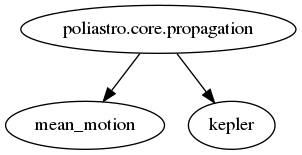

The main purpose of polaistro.core.propagation is to propagate a body
along its orbit.
-
poliastro.core.propagation.func_twobody(t0, u_, k, ad, ad_kwargs)¶ Differential equation for the initial value two body problem.
This function follows Cowell’s formulation.
Parameters:
-
poliastro.core.propagation.mean_motion¶ Propagates orbit using mean motion. This algorithm depends on the geometric shape of the orbit.
For the case of the strong elliptic or strong hyperbolic orbits:
\[M = M_{0} + \frac{\mu^{2}}{h^{3}}\left ( 1 -e^{2}\right )^{\frac{3}{2}}t\]New in version 0.9.0.
Parameters: Note
This method takes initial \(\vec{r}, \vec{v}\), calculates classical orbit parameters, increases mean anomaly and performs inverse transformation to get final \(\vec{r}, \vec{v}\) The logic is based on formulae (4), (6) and (7) from http://dx.doi.org/10.1007/s10569-013-9476-9
-
poliastro.core.propagation.kepler¶ Solves Kepler’s Equation by applying a Newton-Raphson method.
If the position of a body along its orbit wants to be computed for an specific time, it can be solved by terms of the Kepler’s Equation:
\[E = M + e\sin{E}\]In this case, the equation is written in terms of the Universal Anomaly:
\[\sqrt{\mu}\Delta t = \frac{r_{o}v_{o}}{\sqrt{\mu}}\chi^{2}C(\alpha \chi^{2}) + (1 - \alpha r_{o})\chi^{3}S(\alpha \chi^{2}) + r_{0}\chi\]This equation is solved for the universal anomaly by applying a Newton-Raphson numerical method. Once it is solved, the Lagrange coefficients are returned:
\[\begin{split}\begin{align} f &= 1 \frac{\chi^{2}}{r_{o}}C(\alpha \chi^{2}) \\ g &= \Delta t - \frac{1}{\sqrt{\mu}}\chi^{3}S(\alpha \chi^{2}) \\ \dot{f} &= \frac{\sqrt{\mu}}{rr_{o}}(\alpha \chi^{3}S(\alpha \chi^{2}) - \chi) \\ \dot{g} &= 1 - \frac{\chi^{2}}{r}C(\alpha \chi^{2}) \\ \end{align}\end{split}\]Lagrange coefficients can be related then with the position and velocity vectors:
\[\begin{split}\begin{align} \vec{r} &= f\vec{r_{o}} + g\vec{v_{o}} \\ \vec{v} &= \dot{f}\vec{r_{o}} + \dot{g}\vec{v_{o}} \\ \end{align}\end{split}\]Parameters: Returns: - f (float) – First Lagrange coefficient
- g (float) – Second Lagrange coefficient
- fdot (float) – Derivative of the first coefficient
- gdot (float) – Derivative of the second coefficient
Note
The theoretical procedure is explained in section 3.7 of Curtis in really deep detail. For analytical example, check in the same book for example 3.6.
-
poliastro.core.propagation.mikkola¶ Raw algorithm for Mikkola’s Kepler solver.
Parameters: Returns: - rr (~astropy.units.Quantity) – Propagated position vectors.
- vv (~astropy.units.Quantity)
Note
Original paper: https://doi.org/10.1007/BF01235850
-
poliastro.core.propagation.markley¶ Solves the kepler problem by a non iterative method. Relative error is around 1e-18, only limited by machine double-precission errors.
Parameters: Returns: - rf (array) – Final position vector
- vf (array) – Final velocity vector
Note
The following algorithm was taken from http://dx.doi.org/10.1007/BF00691917.
-
poliastro.core.propagation.pimienta¶ Raw algorithm for Adonis’ Pimienta and John L. Crassidis 15th order polynomial Kepler solver.
Parameters: Returns: - rf (array) – Final position vector
- vf (array) – Final velocity vector
Note
This algorithm was drived from the original paper: http://hdl.handle.net/10477/50522
-
poliastro.core.propagation.gooding¶ Solves the Elliptic Kepler Equation with a cubic convergence and accuracy better than 10e-12 rad is normally achieved. It is not valid for eccentricities equal or higher than 1.0.
Parameters: Returns: rr – Propagated position vectors. vv : 1x3 vector
Return type: 1x3 vector
Note
Original paper for the algorithm: https://doi.org/10.1007/BF01238923
-
poliastro.core.propagation.danby¶ Kepler solver for both elliptic and parabolic orbits based on Danby’s algorithm.
Parameters: Returns: - rr (1x3 vector) – Propagated position vectors.
- vv (1x3 vector)
Note
This algorithm was developed by Danby in his paper The solution of Kepler Equation with DOI: https://doi.org/10.1007/BF01686811