Initial Orbit Determination (IOD) module
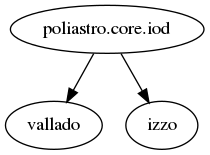

The polaistro.core.iod deals with the problem of determining an orbit
being given two position vectors along it and the that the body takes to travel from
one to another.
This problem is known as Lambert’s problem and many algorithms have developed to solved since the main difficult of it is focused on numerical methods. This module contains two different functions that enable to solve the Lambert problem.
-
poliastro.core.iod.vallado¶ Solves the Lambert’s problem.
The algorithm returns the initial velocity vector and the final one, these are computed by the following expresions:
\[\begin{split}\vec{v_{o}} &= \frac{1}{g}(\vec{r} - f\vec{r_{0}}) \\ \vec{v} &= \frac{1}{g}(\dot{g}\vec{r} - \vec{r_{0}})\end{split}\]Therefore, the lagrange coefficients need to be computed. For the case of Lamber’s problem, they can be expressed by terms of the initial and final vector:
\[\begin{split}\begin{align} f = 1 -\frac{y}{r_{o}} \\ g = A\sqrt{\frac{y}{\mu}} \\ \dot{g} = 1 - \frac{y}{r} \\ \end{align}\end{split}\]Where y(z) is a function that depends on the
poliastro.core.stumpffcoefficients:\[\begin{split}y = r_{o} + r + A\frac{zS(z)-1}{\sqrt{C(z)}} \\ A = \sin{(\Delta \nu)}\sqrt{\frac{rr_{o}}{1 - \cos{(\Delta \nu)}}}\end{split}\]The value of z to evaluate the stump functions is solved by applying a Numerical method to the following equation:
\[z_{i+1} = z_{i} - \frac{F(z_{i})}{F{}'(z_{i})}\]Function F(z) to the expression:
\[F(z) = \left [\frac{y(z)}{C(z)} \right ]^{\frac{3}{2}}S(z) + A\sqrt{y(z)} - \sqrt{\mu}\Delta t\]Parameters: Returns: - v0 (~np.array) – Initial velocity vector
- v (~np.array) – Final velocity vector
Examples
>>> from poliastro.core.iod import vallado
>>> from astropy import units as u
>>> import numpy as np
>>> from poliastro.bodies import Earth
>>> k = Earth.k.to(u.km**3 / u.s**2)
>>> r1 = np.array([5000, 10000, 2100])*u.km #Initial position vector
>>> r2 = np.array([-14600, 2500, 7000])*u.km #Final position vector
>>> tof = 3600*u.s #Time of fligh
>>> v1, v2 = vallado(k.value, r1.value, r2.value, tof.value, short=True, numiter=35, rtol=1e-8)
>>> v1 = v1*u.km / u.s
>>> v2 = v2*u.km / u.s
>>> print(v1, v2)
[-5.99249499  1.92536673  3.24563805] km / s [-3.31245847 -4.196619   -0.38528907] km / s
Note
This procedure can be found in section 5.3 of Curtis, with all the theoretical description of the problem. Analytical example can be found in the same book under name Example 5.2.
-
poliastro.core.iod.izzo¶ Aplies izzo algorithm to solve Lambert’s problem.
Parameters: Returns: - v1 (~numpy.array) – Initial velocity vector
- v2 (~numpy.array) – Final velocity vector